
Home » Uncategorized (Page 3)
Category Archives: Uncategorized
Halévy’s La Juive in Gent by Russell Burdekin
Russell Burdekin is a postgraduate student at Oxford Brookes University, following the nineteenth-century music pathway of the MA in Music
It is not an unusual sight in parts of Italy to see a couple of resplendent ceremonial carabinieri stood at the main door of the opera house for an opera première. The opening night of Halévy’s La Juive at Opera Vlaanderen in Gent on April 15 saw a guard of Belgian police, some with sub machine guns. After last year’s shootings at the Jewish Museum in Brussels, the management were clearly taking no chances that someone might take the opera’s title as a provocation.
La Juive was one of the grandest of the Paris grand operas with one newspaper commenting on the enormous Act 1 procession that “The Opéra may become a power capable of throwing its armies into the balance of power in Europe” [i]. The libretto by Scribe was typical of his style with an unlikely series of events and coincidences vaguely based on historical incidents, in this case in 15th century Constance, and culminating in a sensational ending. It seems that Meyerbeer might have been approached initially to write the music [ii] but it soon devolved on Halévy and the opera premiered on February 23, 1835. Ruth Jordan claimed that the story fired Halévy’s imagination because it brought him “face to face with his [Jewish] heritage” [iii]. However, he did not respond by making use of Jewish music to any great extent nor could much of the music be called particularly inspired; “as for popular music, it has none” was Donizetti’s opinion after seeing it [iv]. However, other composers, including Mahler and Offenbach and, more surprisingly, Wagner, have been more complimentary and, after a shaky start, the opera firmly established itself in the 19th century repertoire.
The opera is a rare beast today and I was particularly interested that Opera Vlaanderen had hired Peter Konwitschny as the director, who is known for his radical interpretations, such as that of La Traviata at ENO in 2013. To complement the opera, Opera Vlaanderen had also organised a two day conference on Judaism in Opera, during which Konwitschny discussed some of his decisions. He explained that he had directed little in the way of French opera, other than Carmen, and had been completely unfamiliar with La Juive until being invited to direct it. He talked of his Brechtian approach, no doubt a legacy of his East German upbringing, that aimed to avoid superficial sentimental emotion (“it’s not just about two poor Jews”) in the pursuit of a longer lasting and more deeply considered response ( “the audience should come out resisting intolerance”). More personally, he had asked himself whether he, as a German, was allowed to criticise a Jew – no doubt having in mind Eléazar’s own intolerance and morally ambiguous behaviour, particularly his lack of honesty with Rachel about her parentage. He then stated that he considered that the opera was too long with too many blocks to the dramatic flow and that the music was not good and had too many choruses. He had thus set about refashioning the opera to provide an exciting and suspenseful evening rather than just a long evening and certainly succeeded in his aim with an absolutely cracking performance that illuminated the spirit if not always kept to the letter of the opera. While this stance is anathema to some opera lovers, it was clear that Konwitschny had given the project considerable thought and was not just wanting to be different or to shock, the motivation that many often ascribe to non-traditional productions.
Konwitschny saw the opera not primarily as Christian and Jew but as persecuting majority and persecuted minority, an essay in intolerance. To this end all wore modern dress with no distinction except that the Christians wore blue gloves and the Jews yellow. Thus he claimed to have deracinated the opera, although I doubt whether many would be convinced about this even if they might agree about his broader message. I wondered whether it was deliberate that he chose yellow for the Jewish gloves bearing in mind the yellow badge that Jews were forced to wear in Nazi Germany but which would have cut across his avowed neutral approach or whether it was an oversight. The set had a huge rose window and other stained glass at the rear, which were lit up for certain scenes and otherwise the main features were groups of vertical metal bars that were arranged in various structures according to the scene. Thus it was a fairly minimal, functional set with no indication of time or place.
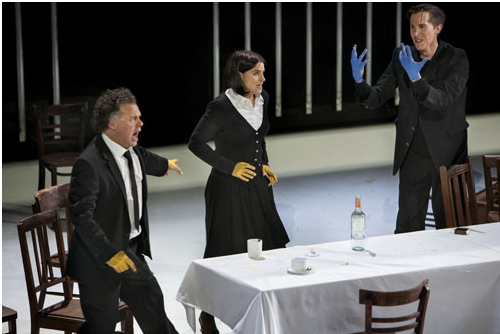
©Annemie Augustijns, courtesy of Oper Vlaanderen
Typical of his reworking of the opera was his removal of the overture so that we plunged straight into the organ introduction to the “Te Deum” and the gathering of the Christians under the leadership of Cardinal de Brogni. Around a further 30 minutes was cut from the earlier part of Act 1 and its lengthy scene-setting. In Act 2, he moved Eléazar’s cavatine to the end of the act because it does not have any specific bearing on the action at that point but is of a more philosophic nature and he wanted to keep up the dramatic impetus with Eudoxie’s entrance immediately following Rachel’s rising suspicion about Léopold when he does not eat the unleavened bread. Act 3 caused the greatest discussion amongst the next day’s conference attendees because when Rachel publicly accused Léopold of being her lover she was shown wearing a suicide belt. Some delegates felt that this ran against Rachel’s role as a mediator and the whole thrust of her personality. Unfortunately, the chairman called time on Konwitschny before he could adequately explain his ideas behind it but he said that he did not consider her as nice a person as some did and seemed to have been thinking in terms of her wanting to destroy the patrimony that was suppressing the world.
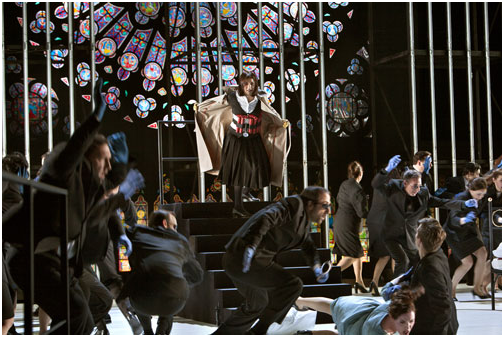
©Annemie Augustijns, courtesy of Oper Vlaanderen
The end of the act saw the chorus, wearing various coloured gloves, constructing an endless series of suicide belts, presumably intimating that we are all complicit in prejudice and its manifest evils. Act 4, in which Rachel and Eudoxie come together in order to save the man who has betrayed them both, had their duet morph into a dance as they celebrated coming together to rise above the hatred that had hitherto permeated the opera and in washing their hands together both divested their gloves.
One of Konwitschny’s techniques was to have singers come out into the auditorium and mingle with the audience while singing, often having them seem to make asides to the audience or to look to the audience for support such as when Rachel, in the auditorium, lambasted Leopold, on the stage, for his duplicity. It gave the exchange a feeling of overhearing someone else’s argument and a much greater involvement than with a traditional stage confrontation. While this sort of manoeuvre is not new, I have never seen it put to such telling effect, although I did sympathise with the woman who sat with her hands over her ears as the volume must have been pretty daunting when Eléazar sang the big hit number “Rachel, quand du Seigneur” a couple of feet away from her.
The end is a problem. Scribe, as was his usual practice, aimed for an arresting stage coup with no regard for its musical potential [v]. Here the opera called for Eléazar and Rachel to be flung into cauldrons of boiling oil with Eléazar revealing that Rachel was Cardinal de Brogni’s daughter as this happened. Donizetti wrote on seeing it, “Too much reality – the final scene too horrifying, the more horrifying because of so much illusion” [vi]. For today’s director perhaps there can be no appropriate realisation living as we do under the shadow of the Holocaust. Here, Konwitschny had them walk up some stairs and then out of sight, while de Brogni fell down the stairs in his surprise and anguish. It served but lacked any real emotional punch.
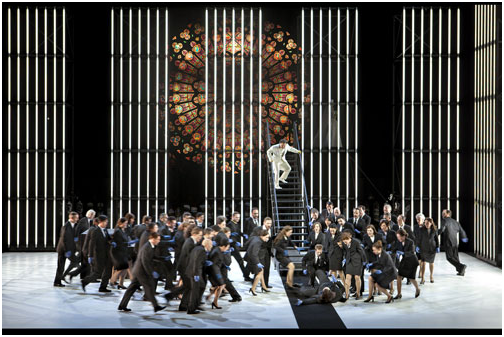
©Annemie Augustijns, courtesy of Oper Vlaanderen
All the roles were strongly delineated, even Eudoxie who can be a somewhat shadowy figure, and all were acted with great energy and commitment. The singing (Eléazar – Roberto Sacca, Rachel – Asmik Grigorian, de Brogni – Dmitry Ulyanov, Léopold – Randall Bills, Eudoxie – Nicole Chevalier, Ruggiero – Toby Girling) was excellent particularly when one considers the very physical acting that they were often asked to do at the same time and the whole enterprise was well supported by the orchestra under Tomás Netopil.
While some opera fans will no doubt decry such manipulation of the opera, it was all in all an intense and exhilarating evening and the audience clearly appreciated it. Unfortunately, on leaving the theatre past the armed police, they needed no reminding that intolerance is still very much with us.
[i] Quoted in Hugh Macdonald, “La Juive”, The New Grove Dictionary of Opera. Vol 2, edited by Stanley Sadie (London: Macmillan Reference Ltd., 1998) , p.926.
[ii] Mark Everist, Giacomo Meyerbeer and Music Drama in Nineteenth-Century Paris. (Aldershot, UK: Ashgate Publishing, 2005), p.221.
[iii] Ruth Jordan, Fromental Halevy. (London: Kahn & Averill, 1997), p.59.
[iv] Quote from a letter to Innocenzo Giampieri in Herbert Weinstock, Donizetti. (London: Lowe & Brydone, 1964), p.108.
[v] “The denouement for which music can do nothing” wrote Donizetti of Scribe’s ending for Dom Sébastien – Zaida and Sébastien fall from the rope they are climbing down to escape – quoted in William Ashbrook, Donizetti and his operas (Cambridge: Cambridge University Press, 1982), p.187.
[vi] Herbert Weinstock Loc. Cit.
Research On The Road by Anna Maria Barry
One of the most enjoyable elements of studying for a PhD is the fact that it presents many opportunities to travel. Admittedly, these trips can often be less than glamorous; a stay in a dodgy hotel in Hull and getting lost in the wastelands of Taunton have not really been high points of my academic career so far.
 A case in point: ‘adventures’ in Taunton!
However, since I started work on my thesis two years ago, I have been lucky enough to visit several new corners of the UK to work in archives and give papers at universities; I even managed to find a good excuse to visit Venice for a conference last year. None of these adventures, however, were quite as appealing as the prospect of a research trip to archives in New York City and Washington D.C.
I work on opera singers of the nineteenth century and, over the course of my research, it quickly became clear that a significant amount of relevant sources were held in American collections. After compiling a list of these sources that numbered into the hundreds, I applied for funding from the Royal Historical Society and the Royal Musical Association in order to make a research trip possible. I was lucky enough to be successful on both counts and so, armed with my list of sources, I boarded a plane for New York City last month.
This was my first ever trip to the US and I was very much looking forward to experiencing research life stateside. My plan was to spend two weeks utilising various collections within three institutions: the New York Public Library, the Morgan Library in New York and the Folger Shakespeare Library in Washington D.C.. My work started several weeks before I left the UK, as a painstaking amount of organisation was needed to arrange access to so many different sources. Within the New York Public Library alone I needed to view material from ten different collections, each of which has its own librarian and several of which are located within different buildings across New York. Because of this, I was a little apprehensive when I turned up at New York Public Library on my first morning in the city.
 New York Public Library

New York Public Library
I had expected the library to be similar to the British Library, which is where I do most of my research in the UK. The feel, however, was quite different. To start with, the sheer beauty of the New York Public library stands in stark contrast to the far more modern St. Pancras site. Despite this grandeur, though, the feel of the library is much more informal. Indeed, it felt more like a local library than a central library; crowds of tourists wandered around taking photos, community groups and teenagers were using the reading rooms and there was always an interesting event going on in the foyer.
I spent a week at the library and, thanks to many helpful librarians, managed to navigate my way around its various divisions. I found far more material than I had anticipated, including very many prints and (literally!) thousands of newspaper articles about British opera singers I am working on. These newspaper articles, located on a database, proved a little bit of an issue as they were tricky and painstaking to save. I am still working through hundreds of PDFs that I saved to my laptop, but the material they contain is extremely rich. The sheer amount of newspaper sources has led me to re-evaluate my thoughts on the celebrity status of these singers, as they clearly had a far greater international profile than I had previously imagined.
I especially enjoyed my time in the Pforzheimer Collection, which contains archives relating to Percy Bysshe Shelley and his circle. This beautiful room looks like a Victorian gentleman’s study and I loved working at an antique desk, complete with a bust of Shelley to keep me company. As I worked in this area, accessible by appointment only, tourists took photos through a glass door. I also spent a day at the New York Public Library’s Performing Arts division, next to the Met. It was excellent to work so close to the opera house and I especially enjoyed the beautiful items that the library displays, in particular the belt that Sarah Bernhardt wore when she played Cleopatra.
 The Pforzheimer Collection
 The bust of Shelley – previous owners include Carlyle and William Bell Scott

The Met by night
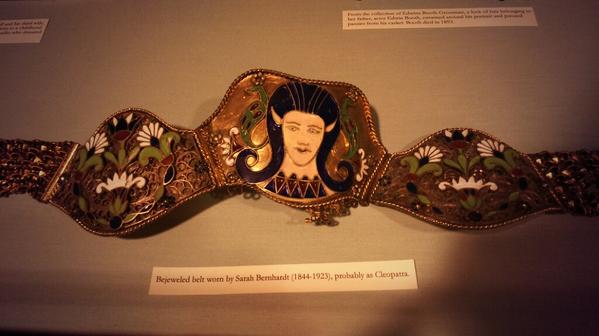
Sarah Bernhardt’s Cleopatra belt
After a week in New York, I travelled to Washington D.C. to visit the Folger Shakespeare Library. I fell in love with Washington, which looked especially lovely with the famous fall colours out in force. A taxi to the Folger took me past several famous landmarks before stopping opposite the Capitol, where the library is very centrally located. This library is also extremely beautiful, packed with fascinating portraits and other theatrical relics. Over a few days, I worked through several collections of important letters, pamphlets and playbills. I especially enjoyed an expedition to the basement, hunting for a dusty old volume; bookcases stretch as far as the eye can see with a phenomenal amount of literature on Shakespeare and the stage. The material at the Folger is extremely rich and I certainly plan to return.
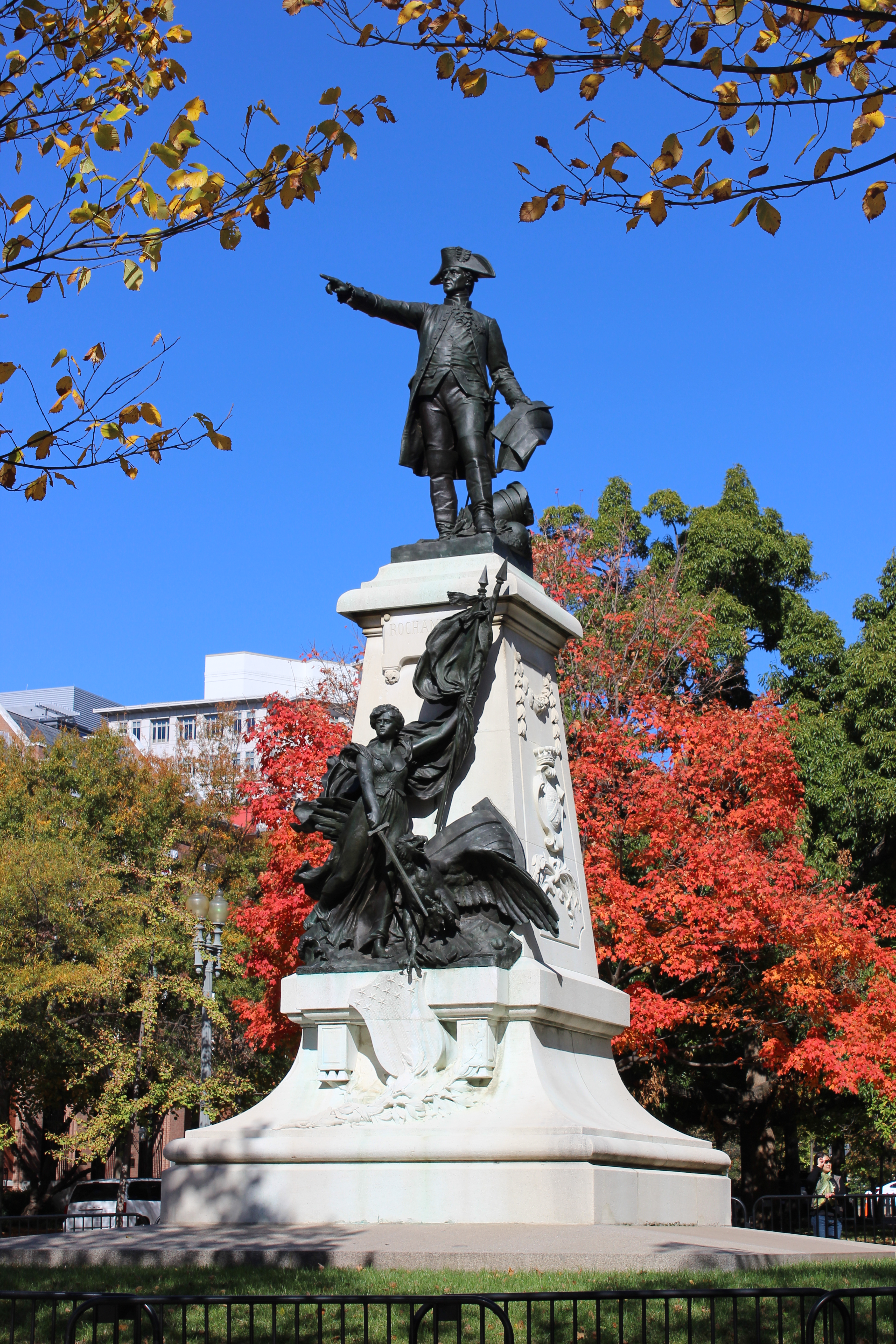 Beautiful fall colours in Washington D.C.
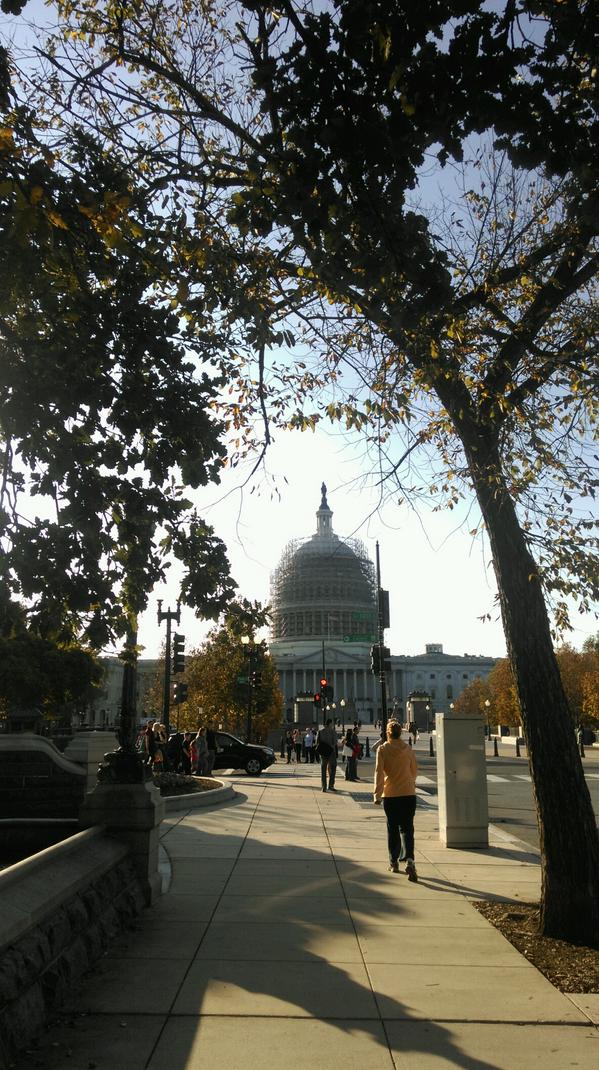
View from the Folger, looking towards the Capitol

The Folger Reading Room
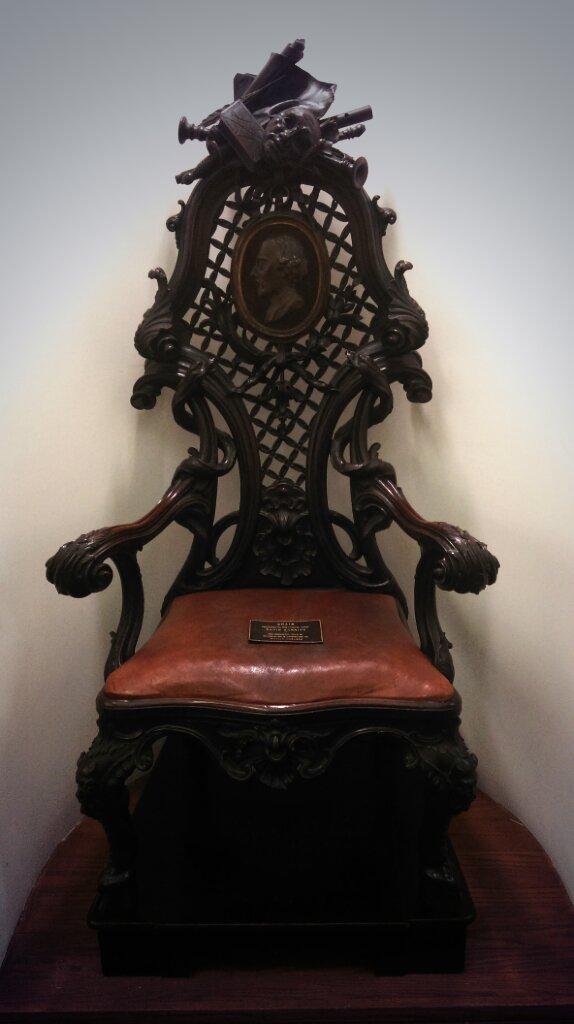
David Garrick’s chair, complete with Shakespeare medallion attributed to Hogarth
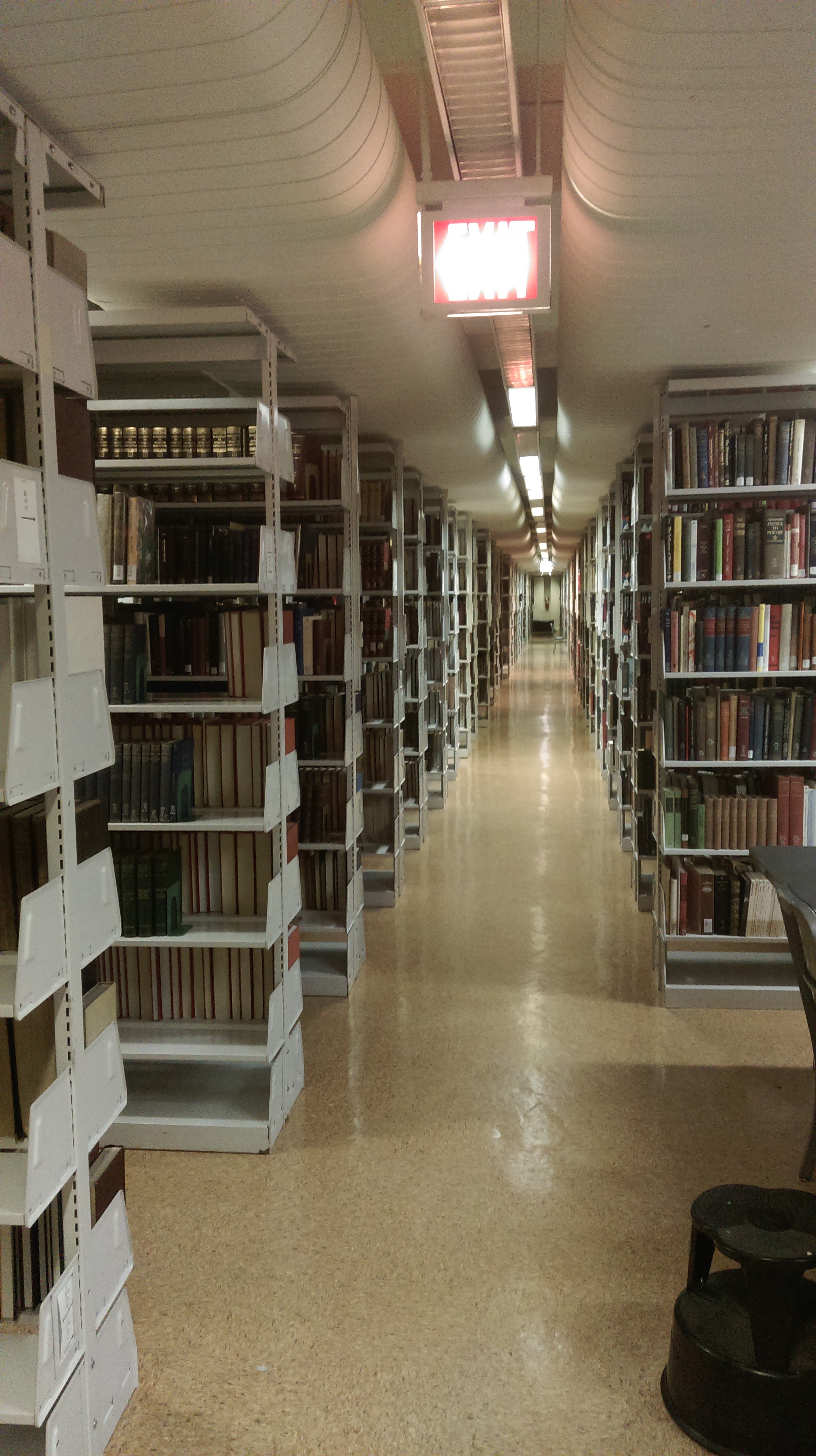
The Folger’s cavernous basement
I headed back to New York for my final week, which I spent at the Morgan Library. The list of materials I had requested to see was so lengthy that I almost sent the librarian’s systems into meltdown, but the staff were extremely helpful and I managed to get through mountains of material over five days. These sources proved extremely rich; letters to and from key singers revealed much new information about their personalities and careers. Many of these letters form part of the extensive Gilbert and Sullivan collections held at the Morgan. Some were extremely touching, describing family tragedies and desperate situations. It was peculiar to spend hours engrossed in these letters, written in nineteenth-century London, before walking out onto bustling Madison Avenue. A favourite discovery was an album compiled by one of Queen Victoria’s servants, containing letters to and from the Queen as well as notes from dozens of key figures of the age; these included politicians, authors, artists and society figures. The album even contained a scrap of the Queen’s wedding dress and some of her artwork. After spending a week in the Morgan’s reading room, I spent some time exploring the rest of the library and Museum. The building is stunning with a library that has to be the most beautiful I’ve ever seen, rammed full of rare books and fascinating artworks.
 The Morgan Library
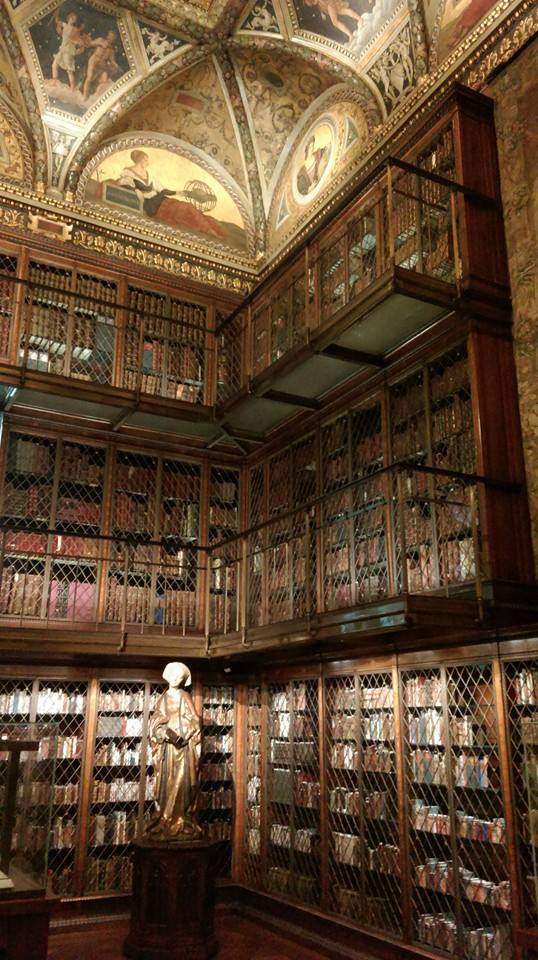
The Morgan Library
My trip to the US was extremely fruitful; over a month after returning, I am still sorting through all of the material that I located! Many of these sources will feature prominently throughout my thesis, but especially in a chapters dealing with the themes of celebrity and touring. It was a surprise to discover just how many sources pertinent to British culture of the nineteenth century are held in America. I would certainly encourage others working on this period to explore what material is held in these institutions. This is very easy to do through their online catalogues, which are detailed and easy to use. I certainly plan to return to the US for future research and have already located certain collections that will be pertinent to my planned postdoctoral research. Watch this space!

New York Public Library by night
Postcard from Vienna (slightly delayed), by Dr Barbara Eichner
If there is one occasion when you hear me sigh: “Sounded like a good idea at the time”, it’s usually when I’ve accepted a conference invitation for mid-semester. Going to a European capital, catching up with old friends and meeting new colleagues are wonderful prospects – six months before the actual event. Back in April, there was optimism a-plenty that I would not just find the time to jet to Vienna and back again, but also to write a fairly original paper on a topic only marginally related to my established research interests in opera and German national identity. Four weeks before the event the flights were duly booked, but the confidence about the presentation had largely evaporated. How did I ever think that I could contribute something meaningful to Christoph Willibald Gluck – Mythen, Bilder, Diskurse, when the line-up featured specialists from the critical Gluck editions at Frankfurt and Salzburg? How would my paper on Gluck and German national opera slot into a programme which also featured presentations on Gluck’s 19th-century biographies, the concept of operatic reform or the image of Gluck as a classicist? I vividly saw myself playing “quotation bingo”: erasing from my paper one quotation after the other as the preceding speakers bagged all the juicy soundbites from Herder, Brendel, Marx et al. So it was with some apprehension that I set out on 22 October for Vienna, my paper completed (or at least written) for better or worse, largely thanks to a kind colleague who had taken on my first-year lecture.
And then it all turned out completely different. The conference itself was impeccably organised by Profs Michele Calella (Vienna), Klaus Pietschmann (Mainz) and Thomas Betzwieser (Frankfurt) and took place in the cosy new rooms of the Österreichische Gesellschaft für Musik (Austrian Society for Music), nestled between the State Opera and the art gallery “Albertina”. As it is customary for symposia on the continent, participation was free, which meant that the conference was attended by a good crowd of students, opera lovers and members of the general public, so conspicuously absent from many conferences in this country because of forbidding fees for bad coffee and limp biscuits. (Actually Michele Calella’s conference assistants spoiled us with home-made muffins.) Discussions were lively, vigorous and well-informed, and we made full use of the 45-minute slots allocated to each presentation. As the topic of Gluck reception was quite new to me, I learned a lot about performances of Gluck in Sweden during the reign of Gustav III (Jens Duffner), Russian culture wars over Gluck (Yuliya Shein), or Debussy’s attempts to erase Gluck’s pernicious Teutonic influence from the annals of French music (William Gibbons).
The highlights for me, however, were two presentations with quite dry-sounding titles: Melanie Unseld’s paper on the Gluck master-narratives in 19th-century biographies of the composer, and Arnold Jacobshagen’s musings on operatic reform and reform opera in 19th-century music historiography. Both speakers took their departure from a special branch of the German intellectual tradition that plays a small role in Anglophone musicology: Begriffsgeschichte, i.e. the history of technical terms and concepts, and Gattungsgeschichte, the history of musical genres. Both historiographical tools have been side-lined in recent years because they seem to sit badly with the myth-busting, hegemony-exposing impetus of the New Musicology, and because in the wrong hands they guarantee hours of unalleviated boredom. (I vividly remember a university seminar presentation I attended as a student where the unfortunate speaker started his analysis of theological messages of a specific Bach cantata by explaining the etymology of “cantata” in the early 17th century, working his way towards the 1720s with excruciating slowness.) The Gluck presentations by my senior colleagues from Oldenburg and Cologne, however, superbly demonstrated how a careful dissection of historiographical concepts illuminates our understanding of music’s place within the wider intellectual tradition of an era.
Melanie Unseld, who has wrote her Habilitation on music history and life writings, investigated a selection of early Gluck biographies, distilling a catalogue of narrative stereotypes (in academic German parlance now called a “Narrativ”, with a long final syllable) such as the humble origins of the artist in a Bohemian village, the misunderstood genius in philistine Vienna, the triumph against adversity in the Parisian querelles. Such narratives sound familiar enough, but Gluck’s “real” life story, as far as it can be reconstructed today, is singularly unsuited to the familiar fairy-tale of the musical genius à la Beethoven. With the help of the narrative tropes, however, the non-Beethovenian aspects of Gluck’s career simply vanish from the storyline: his shrewd business sense (Gluck died a very wealthy man indeed), his uneventful private life (no “immortal beloved” but a marriage that appears to have been as happy as anybody’s), or the fact that he continued writing traditional operas and even ballets after he had allegedly invented reform opera. Melanie Unseld then exemplified her theoretical reflections with a two-page anonymous biography of Gluck written sometime in the 1850s or 1860s, where Gluck is hailed as Wagner’s predecessor but, strangely, his short stay in Copenhagen receives much more attention than decades of Habsburg service in Vienna, playing to the interests of a North-German and progressivist readership.
The title of Arnold Jacobshagen’s paper sounded similar to Unseld’s, but he tackled the operatic reformer from quite a different angle: by tracing the very term “reform” to its origin in late-15th-century theology and church politics. As Jacobshagen argued, thanks to the historiography of the Reformation the term “reform” was understood as a genuinely German form of improving things with gradual and careful steps. In Enlightenment writings, the term was often still used in its French spelling – réforme – but towards the end of the century increasingly construed in opposition – or even as an antidote – to the dangerous French revolutionary tendencies which threatened to throw out the baby with the bathwater. Whereas French music historians customarily hailed Gluck as a revolutionary of French opera, German music historians celebrated Gluck as the master of operatic reform. The dialogue between these seemingly straightforward terms – reform and revolution – suddenly opened up a whole vista of historiographical configurations where not only Gluck, but all 19th-century attempts to push ahead with new artistic development appeared in a new light.
My paper came straight after Unseld’s and Jacobshagen’s, and I have to admit feeling rather self-conscious that my paper lacked a comparable theoretical or methodological foundation, as I placed Gluck in the development of German national opera before and after Wagner. Although no German writer of the 19th century seriously doubted Gluck’s essentially German nationality and national character (see also Eric Schneeman’s inspired blog post about this issue), there was no denying that he had never written a German opera (or even just an opera in German), but concentrated his creative efforts on Italian opere serie and French tragédies. Nevertheless Gluck’s name was often invoked to ward off the dangerous enthusiasm for contemporary Italian opera, playing as it were the bible and garlic to the Rossinian vampires. But that does not mean that his music was a pivotal or even permanent presence on the German stages, nor that young composers invariably looked towards Gluck for guidance and inspiration; Wagner was not the only one for whom Gluck was comfortably dead and buried. Whatever the academic merits of my paper (it can be read in full on academia.edu), at least most of the jokes came off and I introduced a running gag to the conference: Gluck and the German forest. For the published version in the conference proceedings – the organisers will make us work a bit more for the comfortable hotel and the opera tickets – I feel sorely tempted to replace my rather misguided conference title “Zurück in die Zukunftsmusik” with the snappier “Gluck im deutschen Wald”. Side-lining Wagner in a discussion of German national opera is, after all, sometimes not a bad idea.
‘Let the past and its oddness provoke us’ – A day at the Oxford Centre for Life Writing, by Corrina Connor
Biography and life-writing are often central to musicology, and to opera studies in particular. Although my own research does not involve writing a biography of any particular performer, I am investigating the professional – and also the personal – lives of a number of singers who worked at the Theater an der Wien in the 1870s and 1880s. When I saw an announcement for a day workshop called ‘Quest for Materials: Life-Writing Challenges’, run by the Oxford Centre for Life Writing (OCLW), I thought this would be the ideal opportunity to learn techniques for life-writing, particularly as the workshop was directed by Hermione Lee, with Lyndall Gordon, Clare Morgan and Elleke Boehmer, all eminent authors.
I had expected the workshop to explore the nuts and bolts of life-writing: research techniques, or how to search and collate archival finds. Instead, with the participants divided into three groups of about a dozen people, led by Lyndall Gordon, Clare Morgan and Elleke Boehmer, we spent the day in a series of discussions about the challenges – ethical, authorial and paradoxical – of life-writing in a variety of contexts. The participants in my group included researchers from different backgrounds working on biographies, architectural, oral, military and family history. What became obvious was that whether one is working in an academic setting – either as a graduate student or an established academic – or working independently, life-writers face problems which are applicable to musicology. These problems include:
- Finding too much material in archives
- Finding too little material in archives
- Finding vast amounts of material which is not relevant to one’s research, and which takes a lot of time to search with no concrete results
- Feeling lost, helpless and thwarted (by the archive…)
- Finding ‘gaps’ in archival material which can make research feel incomplete or unverified
Then, assuming that the researcher strikes archival gold or even silver (sometimes unexpected or initially irrelevant material can turn out to be ground-breaking), there is the problem of writing it up. Almost everybody in the room said that when writing about a life, they have difficulty in establishing an authorial voice which is appropriate to the subject, and which allows the subject to live. Another problem which arises for many life-writers is that of interpretation. To what extent can the author reflect and interpret their primary source findings? Here, two researchers (PhD students in English Literature and History) commented that reflection and interpretation are one difference between doing a purely academic piece of work – a thesis or journal article – and a biography which might be intended for popular and academic audiences. In the first, an interpretation (as a form of criticism) is imperative for establishing an argument. But, in a published biography, some editors prefer that that ‘facts’ are left to stand by themselves. Of course, the manner of assembling the facts and establishing a narrative is a form of interpretation which is silent, and as subjective as obvious editorialising. Both Lyndall Gordon and Hermione Lee emphasised that as life-writing becomes more experimental in form, there is room for exploring new forms of narrative in which the lives of even the ‘greatest’ people can be approached from creative angles, which require interpretation and criticism to achieve authority.
An example of where interpretation or imagining is necessary could occur in a case where a lucky author finds letters written by their subject and letters written by friends or family of the subject. Such a case allows the author to pick apart the different letter-writers’ view of the subject and his or her thoughts and actions. Even business letters – which may appear mundane and without ‘human’ interest – can paint a compelling picture of a public figure. Our discussion of this topic led to considering how we understand talent, genius or creativity, and – when writing about a creative figure or artist – whether or not to separate the artistry and the person. Everybody in our group had read biographies of an outstanding creative person in which the author’s compulsion to expose every negative characteristic of their subject had made the reader feel uncomfortable. Julia Kavanagh’s Rudolf Nureyev: The Life was cited as an example. Several people in our group had read this book, and agreed that the author’s emphasis on Nureyev’s ‘bad’ behaviour had changed their attitude to his unique talent as a dancer. This was not a sensation that they enjoyed. It was unsettling. At least two of us agreed that this emphasis on Nureyev’s negative traits – whether his poor treatment of colleagues on stage, or his promiscuity – became prurient. It had the effect of forcibly diminishing Nureyev’s extraordinary artistic legacy by not allowing the reader to interpret the material. Hagiography is equally frustrating, but we questioned what was to be gained by writing an exposé
To recover from this passionate debate, practical matters were discussed, especially the most difficult elements of writing anything: how to begin and where to end. All agreed that the beginning is difficult. How to introduce a character, and how to illustrate context are both problems which can halt the momentum of a piece. Lyndall Gordon said there were no magic formulae; she found that choosing a particular moment in a subject’s life – a moment she had found revealing or immediately moving – was often the key. This allows the reader to ‘meet’ the subject. Gordon cited her biography of T.S. Eliot, which opens with a study of Wyndham Lewis’s portrait of Eliot, and her 2005 book Vindication: A Life of Mary Wollstonecraft which begins with Wollstonecraft’s personal reaction to arriving in revolutionary France and witnessing the Terror at first hand. Ending the story is another problem: a life, paradoxically, does not end with a death. An after-life is often more important, especially in the case of lives cut short (think of Schubert, or Wilfred Owen). The reverberations of a subject’s life are integral to their reception and reputation.
To conclude, a representative from each of the day’s groups, and the groups’ tutors spoke briefly to summarise the discussions in each room. Although some of the points are more applicable to authoring a book, these are ideas which are useful for any piece of academic writing, and the common priorities revealed were:
- Establish who you are writing for, and why.
- Decide the extent to which you will ‘editorialise’ and remain consistent
- Consider your attitude to the past. Do not feel oblige to excuse a subject’s behaviour or attitudes, even if they now seem dated or offensive.
- ‘Let the past and its oddness provoke us!’ (as one participant said).
- What is meant by ‘authenticity’? To what extent do ‘facts’ exist? Mediate between contradictory ‘facts’ about a subject’s life. Never exclude what you don’t like.
- True authenticity lies in the writer’s passionate commitment to (but perhaps not involvement with) the subject.
This is just a snapshot of the day. I recommend attending events run by the OCLW for stimulation, motivation, and the opportunity to meet some remarkable colleagues.
Nureyev link
http://www.theguardian.com/books/2007/sep/23/biography.features1
OCLW link
PhD studentship – Religion and ‘the Church’ on the Nineteenth-Century Stage
Oxford Brookes University
150th Anniversary PhD Scholarship
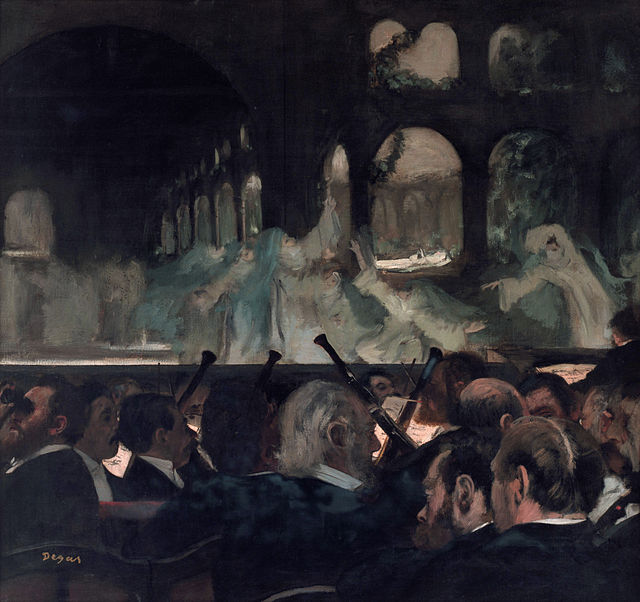
Edgar Degas, The Ballet from Robert le Diable, 1871
OBERTO are very pleased to offer a three year full-time PhD scholarship to a new student commencing in January 2015. The successful applicant will receive an annual bursary of £7,000 for three years (with no inflation increase), and fees will be paid by the University. The candidate will need to demonstrate that in addition to the scholarship other funding is available for them to successfully complete the programme in full-time study.
The successful candidate will work within the School of Arts under the supervision of Dr Barbara Eichner.
Topic of research: Religion and ‘the Church’ on the Nineteenth-Century Stage
This project will investigate the manifold ways in which religion, spirituality and ‘the Church’ were represented on the nineteenth-century (operatic) stage. The ‘long’ nineteenth century is often characterised as an era of secularism, rationalism and materialism. Despite this – or perhaps as a counter-reaction to it – religion, rituals and mysticism continued to fascinate composers, librettists and singers. The nineteenth-century stage offers particularly rich pickings in this area, from the use of chorales as musical markers of historical distance to the salacious nuns’ ballet in Giacomo Meyerbeer’s Robert le diable.
This project will allow the recipient of the doctoral award to investigate the representation of religion on the nineteenth-century stage from a number of angles, such as (but not restricted to):
- musical historicism and the sounds of religious music
- religious roles and voice types, from the ethereal nun to the evil cardinal
- influences from other genres, such as oratorio, cantata or liturgical music
- church criticism, parody, blasphemy and censorship
- staging religious rites
- contemporary church politics
- encounters with non-Christian religions and atheism
The scope of the project is not limited to a particular national ‘school’ or geographic area; it will build on the prior knowledge and interests of the recipient of the scholarship. However, a comparative approach is strongly encouraged, and at least one of the major traditions (Italian, German, or French) should be included.
The recipient of the scholarship will be part of the thriving research culture of OBERTO. All our staff and PhD students are working on topics that concern opera’s relationship to broader cultural debates and questions of identity during the long nineteenth century. The recipient of the scholarship would be encouraged to take a pro-active role within the research unit, and to communicate their research findings to wider audiences.
Further information about the OBERTO research unit can be found at www.obertobrookes.com.
For information about the prospective supervisor, Dr Barbara Eichner, consult her profile on http://oxfordbrookes.academia.edu/BarbaraEichner. Informal inquiries to barbara.eichner@brookes.ac.uk are welcome.
If you would like to apply you should request an application pack from Ms Zane Kalnina tdestudentships@brookes.ac.uk, quoting ‘Religion in Opera’ in the subject line. Fully completed applications must be sent to the same email address by 31 October 2014.
As part of the application you should submit a CV, a research proposal (maximum 3 pages), together with a supporting statement summarising your reasons for undertaking this project, preparation undertaken for your project, as well as a summary of your previous research experience.
Please be advised that the selection process may involve an interview on 13 November 2014, and the successful candidate would be expected to commence in the research degree programme in January 2015.
The Opera Stereotypes Alphabet by Dr Barbara Eichner
At the end of our recent conference Beyond Black Tie and Bubbly: Rescuing Opera from Stereotypes, I tried to kick off the general, final discussion with the following ‘alphabet’ that unites beloved buzzwords, common clichés and time-honoured tropes.
A is for accessibility: opera is more accessible today thanever before in its history – something that’s easily forgotten
B is for bums on seats: the bottom line of the impresario
C is for crossover: way forward or cul-de-sac?
D is for dumbing down: the pet hateof the conservative establishment
E is for education: can we be taught to love opera?
F is for fan base: who are they, and what keeps them happy?
G is for government funding: predictably enrages ‘the taxpayer’, though considerably lower than in many other European countries
H is for HD Cinema Broadcast: currently the Holy Grail in reaching audiences beyond the opera house
I is for impact: the persistent need to prove that opera and opera studies are relevant to society
J is for journalists: is it them who won’t let the clichés die?
K is for Katherine Jenkins: you know, the opera singer (or is it ‘opera singer’?)
L is for luxury: see also class
M is for marketing: hype, hype, hype
N is for new audiences: what’s wrong with the old ones?
O is for outreach to ‘ordinary people‘: the group that allegedly would never go to the opera
P is for privilege: see also class
Q is for quality versus quantity
R is for Royal Opera House versus Royal Variety Show
S is for sexing it up: see also dumbing down
T is for taste: is opera an expensive acquired taste?
U is for Unterhaltungsmusik: indeed, opera was and is still part of that
V is for Victorian popular opera: when did opera stop to be enjoyed by the many in seaside resorts, music halls and brass band concerts?
W is for working class: does it make some people feel apologetic about liking opera?
X is for X-Factor: plenty of opera there, but is it the ‘real thing’?
Y is for Why do we worry about operatic stereotypes?
Z is for …
… at this point the discussion took over, and a long, spirited and fruitful discussion it was!
Opera Research Students’ Conference Report by Anna Maria Barry and Corrina Connor
On Tuesday 17th June the inaugural Opera Research Students’ Conference was held at Oxford Brookes University, hosted by OBERTO. This conference, organised by OBERTO postgraduate students, attracted 14 speakers from the UK and beyond. The speakers spoke in 6 sessions, encompassing a diverse range of approaches, from economics and psychology to composition and archaeology.
Things kicked off with two parallel sessions, one of which was entitled ‘Performance Practices’. The first speaker in this session was Matteo Paoletti (University of Genoa), who spoke about the career of director Giorgio Strehler and his pursuit of a ‘lyrical theatre of art’. Strehler believed that for this ideal to be attained, singers had to be ‘theatrical animals.’ Strehler died during the rehearsals for his 1998 production of Così fan tutte and no one has ever studied his work. Paoletti’s fascinating paper was followed by one from Anna Koukoullis (Oxford Brookes University), who spoke passionately about the evolving role of acting on the operatic stage. She showed clips from different productions of Carmen to highlight the change from ‘presentational’ to ‘representational’ acting, and considered how acting is taught to young singers in conservatoires today.
Meanwhile, in the parallel session ‘Production and Creative Process’, we heard two more speakers. First up was Emma Higgins (NUI Maynooth), who spoke about the status of the mezzo-soprano in early Third Republic Paris. The truth seems to be that the ‘mezzo’ as a category did not exist in name at the Paris Opéra (although singers were expected to perform mezzo roles): the most prestigious female vocal categories were those of the soprano and contralto. Next, Simone Spagnolo (Trinity Laban) discussed Italian experimental opera in the second half of the twentieth century, using Berio’s Opera and Bussotti’s Passion Selon Sade as examples of alternative narrative forms which can mean many things (or nothing at all) according to the multiple interpretations of the audience. Spagnolo also discussed his own opera It Makes No Difference in the context of the ‘open work’. This paper, overall, demonstrated that the creation of an open work requires ingenious planning, and it was fascinating to see the difference intellectual processes which are necessary for creating a ‘convincing’ open work.
After a short break, delegates came together for a three-paper session entitled ‘The Business of Opera’. Alessandra Palidda (Cardiff University) got things started with a highly amusing paper on La Scala in Napoleonic Milan. Just one of the republican-flavoured works that was performed during this period was the ballet Il general Colli in Roma which featured a dancing Pope on stage and became known as ‘the Pope’s ballet’. Next, Matthew Elliot (Emmanuel College, Cambridge) brought the finances of French Grand Opera alive, with a look at the finances and funding of the Paris Opéra. The amounts of money it took to keep the art form alive were staggering, and losses were abundant; not helped by the bizarre condition that stage sets could not be re-used for subsequent productions. The last speaker in this session was Annabelle Lee (RHUL), who offered a fascinating insight into the Metropolitan Opera’s social media strategy. Lee ultimately concluded that we should be rather wary of claims that social media strategy is able to bring new audiences to the opera house. Some of her figures were surprising; for example, audiences over 55 are more likely to experience opera via digital media.
Following lunch was another session of three papers, entitled ‘Cross-cultural reception’. The first speaker was Corrina Connor (Oxford Brookes), who gave a colourful account of the 1876 arrival of Die Fledermaus in London. Particularly interesting was the way in which social and political events had an impact on the reception of this opera, and its subsequent revival in 1895. Next, Zara Barlas (Heidelberg University) gave a fascinating account of Edward Soloman’s operetta The Nautch Girl. This opera reflected colonial anxieties about Indian dancers, who were erroneously seen as prostitutes. Barlas demonstrated how this opera might be viewed through a colonial lens, offering new perspective on transculturality during this period. The final speaker in this session, Catherine Hutchinson (Goldsmiths), spoke of the lavish 1860 production of Sémiramis at the Paris Opéra. Particularly fascinating was Hutchinson’s description of how recent archaeological finds from Assyria, displayed at the Louvre during this period, were reflected in the sets of the production.
After another short break, delegates split for two more parallel sessions. One of these was entitled ‘Psychology and Listening.’ First up, David John Baker (Goldsmiths) shared the fascinating research he is undertaking as part of the ‘Transforming Musicology’ project. Baker has been working with many listeners, testing which factors affect their recognition of Wagner’s Leitmotifs. This study has so far yielded some surprising results, and Baker’s paper offered some intriguing insights into how the brain processes music. The last speaker in this session was Sebastian Bolz (LMU Munich), who offered an examination of the operatic chorus in Germany around 1900. This understudied area, Bolz argued, can offer a new perspective as a medium for group dynamics.
The final parallel session was entitled ‘British Literary Adaptations’. The first speaker, Russell Burdekin (Oxford Brookes), illustrated the lurid origins of Loder’s opera Raymond and Agnes, which was derived from the sensational Gothic romance The Monk (c. 1795) by Matthew Gregory Lewis. Burdekin explained that as theatre productions were subject to censorship in the early nineteenth century, it was necessary for stage adaptations of The Monk to tone some of the most scandalous aspects of this book which also had a plot too convoluted to be easily enacted on stage. Michael Tippett’s The Knot Garden was also derived from an earlier literary source, in this case Shakespeare’s The Tempest. Michael Graham’s (RHUL) paper focussed less on Tippett’s adaptation of the story than it did on the significance of ‘Der liebe Farbe’ – a song from Schubert’s cycle Die schöne Müllerin –which two of the opera’s characters (Flora and Dov) sing in Act II. Graham discussed the significance of the song for the ideas of gender mutability which pervade The Knot Garden.
The conference finished with a brilliant keynote from OBERTO’s Dr. Alexandra Wilson who offered much practical career advice for opera studies students, as well as sharing her own experiences and top tips. Alex began her talk by saying how pleased she was to see so many diverse and imaginative approaches being taken to opera studies and by noting that ‘The field is clearly in good health!’ Students found it especially useful to be able to ask questions and discuss topical issues such as public engagement and the REF. Please see Dr Wilson’s seperate blog post about this talk, where she shares her ‘top tips’. Delegates then held a short discussion about the future of the Opera Students’ Network, and many suggestions were made including regular social events, a new blog and website, and collaboration with singers and opera houses. We will be meeting shortly to discuss how to take some of these ideas forward – watch this space!
After the conference everyone headed to a local pub, where mutual areas of interest were discussed and new friendships were forged. It was extremely valuable to bring opera research students from around Europe together to discuss their research, as people working in disparate areas were able to come together share their work and ideas in a fun and dynamic environment. We eagerly look forward to next year’s conference!
London Nineteenth-Century Seminar Graduate Conference: Reflections from an Opera Studies Perspective by Corrina Connor
The London Nineteenth-Century Studies Seminar takes place regularly on Friday evenings at the Institute of English Studies at Senate House Library in London. The Seminar also organises a day conference for graduate students researching the long nineteenth century, and this year – generously supported by UCL and QMCUL – the conference took place on 26 April in the Court Room at Senate House. While there were no musicological papers in any of the panels, there were contributions from graduate students at MA and PhD level in history of art, English literature, history, and modern languages; their incredibly diverse areas of research filled a day that illustrated many extraordinary aspects of nineteenth-century culture.
The day began with a keynote from Professor Cora Kaplan, whose lecture ‘Loving Dickens and Dickens in Love’ asked ‘what do we mean when we say we “love” an author?’ Kaplan explored the problems of biography for an author who is acknowledged to be a ‘cultural icon’ and ‘national treasure’. She also discussed the public images which Charles Dickens created for himself, the breakdown of his marriage and family, and his relationship with Nelly Ternan. There is huge conflict between these aspects of his life, and late twentieth and early twenty-first-century attitudes towards marriage and family, particularly if we read his fiction as autobiographical. Kaplan reminded us of the difficulty of separating the man and the writing, which is a problem which also affect musicologists; in opera studies especially it is even more tempting to read autobiographical references in a composer’s choice and treatment of libretto. The second part of Kaplan’s lecture discussed how a modern audience deals with melodrama and realism in nineteenth-century literature (specifically Dickens), and her comments on the collision between melodrama and realism in his fiction, as well as in biographies and the recent film The Invisible Woman were pertinent to understanding better some of the more improbable – and to our minds sometimes repellent or misogynist – aspects of later nineteenth-century opera.
The student panels began with a session on ‘The Body and Representation’, which included papers on corsetry and photography (Beatrice Bazell, Bickbeck), parallels between narratives about childhood by Stephen King and in David Copperfield (Katie Bell, Leicester) as well as ‘enforced maturation’ in Lewis Carroll and how Tenniel’s illustrations enhance these themes (Jasmine Jagger, Cambridge). Jessica Hancock, a DPhil student at Oxford University, spoke about musical training and performance as expressions of masculinity in William Morris’s Sigurd the Volsung– his rewriting of the Poetic Edda and Volsunga Saga – which created an indirect link between Morris’s exploration and re-casting of these Norse legends and Wagner.
After lunch we moved away from the matters of the body for the second panel, ‘A Culture of Paper and Print’. Here, the birth of the ‘New Journalism’ epitomised by the bold style of W. T. Stead in the Pall Mall Gazette (a style and a paper both admired and decried by Matthew Arnold and Edmund Yates) was dealt with by Philip March (Birkbeck) in the context of the religious views of these three men; Melissa Score (Birkbeck) also discussed the ‘New Journalism’ but in an examination of newspaper taxation and press regulation. Ideas about increasing readership and accessibility, the social and political importance of newspaper journalism, and a perceived bias towards sensation and celebrity are all relevant to opera studies scholars, as newspapers are an important source of material about opera reception and celebrity culture. Alexandra Ult (UCL) spoke about ‘Victorian Media Hierarchies and the Printsellers’ Association, 1840-1912’, revealing the relationship between prototypes (in this case John Everett Millais’s Minuet), replicas made by Millais, and engravings of the picture which were immensely popular. Engravers were considered artists in the own right, the engraving and printing industries were vast enterprises carefully regulated by the Printsellers’ Association, and prints were the means by which ‘ordinary’ people could enjoy ‘art’ at home. Again, the issues about intellectual property, copyright, and the dissemination of art in society had parallels with the ways in which images of singers were disseminated in the nineteenth century and arrangements of operatic music which could be played at home. Finally, there was a fascinating paper from Kathleen McIlvenna about occupational pensions for “Old and Worn Out” workers in nineteenth-century Britain. I cannot, despite a lot of hard thinking, make any connections between the Civil Service Superannuation Act of 1859, how white-collar and working class employees of certain companies and organisations (in this case, the East India Company and the Post Office) were supported in old age and decrepitude by their former employers, and issues pertinent to opera studies. However the paper illustrated fascinating aspects of nineteenth-century working lives and legislation, and is relevant today, when pensions, welfare, and the retirement age are still politically contentious.
I couldn’t stay for the third and fourth panels (‘Perceived Places’, and ‘Experiential Space and the City’), or the Plenary from Matt Rubery (QMCUL), but the programme can be found here. The Nineteenth-Century Seminar is a valuable resource for anybody studying nineteenth-century culture, and I plan to attend more of their regular Friday afternoon sessions.
OBERTO opera trip 2014
In February, a group of OBERTO staff, undergraduates, MA students and PhD students attended English National Opera’s new production of Rigoletto, directed by Christopher Alden, at the London Coliseum. Below three students respond to the production.
Corrina Connor
‘With many details of James Hepokoski’s chapter ‘Staging Verdi’s Opera: the Single “Correct” Performance’ from Alison Latham and Roger Parker’s Verdi in Performance fresh in my mind from the morning’s MA seminar, I was eager to see and hear the extent to which Christopher Alden would deal with the four elements of dramma which Verdi had wished to have ‘interact with exquisite balance: text, music, vocal display, and stage picture’. In fact, I made a conscious effort to think about how these elements worked together throughout this performance of Rigoletto. Although my ability to do this was inconsistent, so was the interaction of elements. While the stage picture was almost always pleasing, it was also confusing: having one basic set made it difficult to discern which location we were in – the Duke’s court accommodation, Rigoletto’s own home, or the inn where Sparafucile is going to kill the Duke – and the contrast between these locations seems important, especially as Gilda’s apparent complete separation from Rigoletto’s life at court is fundamental to the story.
Some aspects of Alden’s production affected me especially, and even after seeing three more productions (on DVD) since, these particular strengths remain significant. The appearance of the tableau which opened Act I brought to life the colours, light, and aspects of composition of two paintings I saw recently: Jean Béraud’s La Salle de rédaction du Journal des débats (1889), and Henri Fantin-Latour’s Hommage à Delacroix (1864). Both of these paintings depict closed, all-male groups in a way that is unique to the nineteenth century. While both these pictures are representative of completely different social situations to that of the Duke of Mantua’s court in Rigoletto, the staging at the beginning of Act I was powerfully evocative of the nineteenth-century milieux of these paintings. In this context the manner in which the women of Rigoletto deported themselves, and their interaction with the men, was reminiscent of Manet’s Le déjeuner sur l’herbe (1863), although in this particularly production of Rigoletto, remarkably, nobody on stage was ever quite naked. Here, the mise-en-scène was ingeniously suggestive of social situations in which the veneer of propriety is very, very thin, reminding us that particular forms of hypocrisy which now we may associate with the nineteenth century may not be so foreign after all. Happily, these qualities of the production compensated for the blinding chaos at the end of Act II, and the inconsistencies at the end of Act III: Rigoletto and Sparafucile’s discussion of how and where to dump the body in the river lost a lot of its significance, and the moment of horror and despair when Rigoletto hears that the Duke is not dead was diluted by the unambiguous presence of the Duke, sauntering across the stage. These objections aside, this production of Rigoletto was an engaging and disturbing approach to an opera whose themes have a contemporary resonance’.
David Marks
‘The set was innovative and for the most part it worked with clever use of lighting but I thought that at the end in the final scene in which Gilda dies, the set lacked the intimacy that I have seen in other productions and which is important to the emotions being conveyed. Also when Sparafucile murders Gilda at the Inn, it was difficult to imagine an important change in location given that the set was the same’.
Anna Barry
‘The sets were visually very impressive, evoking the atmosphere of a nineteenth-century gentleman’s club very effectively. The way that space and time were depicted within this set, however, did get a little confusing at times. Most impressive was the far simpler staging of the final scene, with Gilda lying on a plain white sheet in the centre of the stage. I found the contrast to the scale and detail of the previous sets very effective, and this made for a moving and powerful final scene’.
The popular discourse of anniversaries: Strauss & Co. By Hugo Shirley

Verdi and Wagner battle it out. (Photo from http://blog.staatsoper.de/blog/verdi-boxt-mit-wagner)
I’ve already mused elsewhere on the benefits or otherwise, in terms of programming, of the Strauss anniversary this year. In this post, however, I’d like to examine briefly how anniversaries (the theme of last September’s Oberto Conference) seem to affect the broader popular discourse regarding composers, and how, it seems, the extra exposure that anniversaries–very much double-edged swords–bring can, arguably, be helpful.
Of course, new exposure to a wider audience is to be welcomed. But the challenge is surely to bring renewed exposure that is not automatically simplified. Anyone following the great anniversary face-off in 2013 between Wagner and Verdi must have wondered, for example, if it was entirely necessary for those two composers to be pitted against each other in the way that they were. We see this conflict presented (and clearly satirised, too) in unsubtle allegorical form in this still (above) from a Bavarian State Opera publicity film.
In Britain, however, one could barely move for ostensibly more high-minded debates that, in trying to assess the very different forms of greatness of each of the composers, inevitably became reduced to a game of slinging standard, negative slurs: Wagner was an anti-Semitic megolamaniac whose works were overblown, bombastic etc. etc; Verdi, though admittedly a nicer chap, churned out tunes without ever much intellectual engagement. At its worst, the debate dissolved into barely-masked, centuries-old xenophobic stereotyping, with Wagner and Verdi there only as token representatives of their nations. Of course the media have to balance subtlety with the sort of headline-grabbing contrast and conflict that will draw readers in, but it seemed as though neither composer ever came out of the debates very well.
I’m concerned, too, that similar polarisation is at play already in the Strauss anniversary. Although, in this case, it’s the pitting of two aspects of the same composer against one another. This tweet from Radio 3’s In Tune sums it up:
 A think piece in the Guardian, meanwhile, was called: ‘Richard Strauss: Profound Genius or Gifted Entertainer?’, with Tom Service further asking, ‘Is his description of himself–“I may not be a first-rate composer, but I am a first-class second-rate composer”–mere modesty or the simple truth?’
First, of course, the idea in itself of the ‘simple truth’ is not, well, as simple or truthful as we’d like to think. Second, Strauss’s own descriptions of himself seemed, in my view, calculated specifically to undermine any attempts at canonization, the need to rank and rate composers, to place them within a convenient narrative. (Another earlier and more easily verified quotation along these lines comes from a piece by Strauss, asking, significantly, ‘Is there an Avant-Garde in Music?’, which he wrote in the first issue of new Berlin Journal, Der Morgen, in 1907. ‘Nachdenken ist immer unangenehm’ [thinking is always unpleasant], he claimed there, mischievously and provocatively.)
Strauss, of course, avoids such narratives, and the revisionist assessments of the composer over the last couple of decades have, in some ways, only emphasized how slippery and, to use a favourite word, enigmatic the composer remains. One commenter on the Guardian piece rightly asked whether or not a composer can be a profound genius and gifted entertainer. And whatever one might feel about ‘the music itself’, surely this composer’s interest and fascination lies in the fact that he was both. Perhaps the anniversary discourse should move onwards and upwards to examine that.
Elitism and the ‘opera snobs’: a response to Katherine Jenkins by Alexandra Wilson
Last week the ‘classical crossover’ singer Katherine Jenkins held a reception at the Ritz in order to promote her new record deal. The event might have gone unnoticed by all but Jenkins’ (admittedly sizeable) fan base, had it not been for the provocative headline under which The Telegraph reported the event: ‘Katherine Jenkins: why classical music snobs are wrong’. A storm swiftly erupted in the Twittersphere.
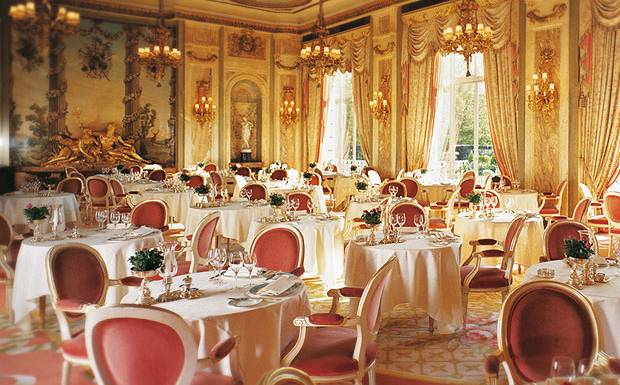
The Ritz, London
Jenkins apparently stated: “There will always be a small number of critics who want to keep [opera] to themselves and an elite, but I’ve always been of the opinion that classical music is for everybody and I want to make it as accessible as possible – I’m from a normal background”.
Jenkins’ comments were, presumably, intended as a swipe at those who do not like her style of crossover music, nor the way in which she is often labelled an ‘opera singer’, nor the fact that she was recently awarded an OBE for ‘services to music’. No public figure enjoys negative press, of course, but for Jenkins to accuse those who criticise her on musical grounds of ‘want[ing] to keep opera to themselves’ is deeply disingenuous.
Who, indeed, are these so-called music ‘snobs’? The term hardly seems applicable to today’s opera critics, many of whom reflect regularly on issues of accessibility in their reviews. Opera companies, meanwhile, expend vast amounts of energy organising education and outreach projects, taking opera into such diverse settings as schools, shopping centres and prisons. And even opera scholars are, these days, to be found regularly sharing their research with the public and trying to expand the audience for opera through pre-performance talks, radio programmes, blogs and podcasts.
Just like Jenkins, all of these groups are committed to the idea of opera being ‘for everybody’. Where they differ from her, however, is in their confidence that opera can stand on its own terms without needing a helping hand from popular music. Sometimes the juxtaposition of opera with other genres produces interesting results. However, to imply that ‘ordinary people’ need opera to be packaged as pop is insulting, just as it would be insulting to imply they could only understand a classic novel if it were presented in comic-strip format.
With her faux naive comment about being ‘from a normal background’, Jenkins (who had the privilege of being educated at the Royal Academy of Music) is doing her fellow musicians a profound disservice by stoking the flames of a debate about the ‘e-word’. When opera is discussed in the British media it is, almost without fail, crudely styled as the antithesis of popular culture and all things ‘ordinary’. It’s a mischievous conceit and one that actually sets up barriers: indeed, one might argue that it is the press stereotype of opera that makes opera appear ‘elitist’ rather than the art form itself.
All of this smacks of a peculiarly British unease about opera that has long and complex historical roots. Look back to nineteenth-century discussions about opera and you will find comments aplenty that smack of xenophobia on the one hand (foreign opera singers ‘coming over here and stealing jobs’) and an inferiority complex on the other (British composers couldn’t hold a torch to the Italians or Germans). In the early nineteenth century, opera-going was undoubtedly dominated by a foppish aristocracy the middle classes had little desire to emulate. But by the end of the century, as Paul Rodmell has demonstrated in his excellent new book, more British people had access to live opera than at any time before or since, thanks to a flourishing culture of touring opera. As the twentieth century went on, however, something fundamental would change (a development I plan to investigate in my next research project), until the point where the pernicious assumption that opera is ‘elitist’ had become the default setting in the British media.
In the opera courses I teach, I make sure that I get the ‘opera and elitism’ conversation out of the way in the first week. I ask the students to list all the respects in which opera could be considered ‘elitist’ and then ask them to challenge their assumptions. We usually agree that there are certain ‘trappings’ of opera that might smack of wealth and privilege (although why should red velvet curtains and gold paint be called ‘elitist’ when super cars and high fashion are considered ‘aspirational’?). However, when asked to consider how operas themselves might be meaningfully labelled elitist, either in terms of plot or music, the students inevitably struggle. Are operas ‘elitist’ because they sometimes tell stories about kings and queens? Or because they demand a reasonably long attention span? Since the same applies to many a popular historical film, these lines of argument swiftly go nowhere.
How ironic it is then that Katherine Jenkins should have bought so wholeheartedly into the luxurious ‘trappings’ of opera with her promotional event at the Ritz, while simultaneously alluding to stereotypes that do considerable harm to the image of an art form for which she claims to speak. One can only speculate at her motive for perpetuating the myth.
Dr Alexandra Wilson, Reader in Music at Oxford Brookes University, has presented opera broadcasts for BBC Radio 3, given educational talks for ENO, the Royal Opera House, Glyndebourne and the Proms, and written programme essays for the Royal Opera House, Wexford Festival Opera and opera companies across Europe. Her book, Opera: A Beginner’s Guide, seeks to demystify opera and demonstrate its relevance to contemporary life.
Opera Tickets for Students
Did you know that both the Royal Opera House and English National Opera offer brilliant benefits for students, with many cheap tickets available?
The Royal Opera House runs a fantastic Student scheme – free for all students to sign up to online. Once they are registered students get an advanced booking period, making it easier for them to purchase cheaper seats before they go on general public sale. In addition, 20 of the cheapest seats for every performance are now reserved for students only – these can cost as little as just £4! There are also several dedicated student performances every season, and students are offered discounts at the bar and on programmes. In addition, the ‘Student Standby’ scheme offers unsold tickets to performances for just £10. Student booking for the Spring season opened at 10 am this morning – sign up quickly to get tickets for some fantastic productions!
English National Opera has a scheme called Access All Arias for students and those aged under 30. Under this scheme, students are able to buy heavily discounted tickets for every performance – these cost as little as £10 each. Programmes are also half price and cheap, last-minute tickets are often made available.
Wandering Minstrels: Travelling Opera in Britain – Conference Report
On 26 October, a group of OBERTO staff and students attended the ‘Wandering Minstrels: Travelling Opera in Britain’ study day at the Royal Academy of Music. Here are some of their responses to the day.
MA student Pauline Galea writes:
I particularly enjoyed Dr Paul Rodmell’s session on ‘Unsung Heroes, 1875-1919’. His overview of the range of touring opera companies in England during that period, their repertoire and their performing schedule, painted a very vivid picture of the importance of the touring system. It was interesting to note that opera companies then, as now, needed to maintain a balance of producing ‘old favourites’ to bring in the revenue, but also regularly commissioned new works, and also that the principal language for touring companies was English, with the attendant requirement to arrange translations.
MA student Anna Koukoullis writes:
I was most drawn to comments made by Dr John Ward, who presented a paper on the history of the Carl Rosa company. This was particularly interesting as it discussed Rosa’s thoughts not only on repertoire, but production issues. Dr Ward was able to show us a primary source that contained a sketch of the vision Rosa had for the staging of a particular project. Touring opera companies often find their ambitions for the staging of a work limited by being on the move, and performing in a variety of venues of differing size. This inspired me to ask the question, how does touring limit what companies can do visually and dramatically on stage? And do these limitations affect how they bring opera to the masses?
 Carl Rosa
PhD student Anna Maria Barry writes:
The most interesting session for me was ‘English Touring Opera and the Impact of Cinema Broadcasts’. This paper concerned a research project that is currently underway examining the fast-growing trend for operatic cinema broadcasts and the impact this may be having on the audiences for live opera. English Touring Opera traditionally serves audiences in towns and rural communities where live opera is not available. Now, however, the majority of these communities are able to access world-class cinema broadcasts from the Met and the Royal Opera House. The research project is surveying audiences in order to learn more about the perceived advantages and disadvantages of opera in the cinema. It is hoped that the results will allow English Touring Opera to adapt to a changing marketplace for opera. Although the project is still ongoing, initial audience responses raise some interesting and surprising questions about the nature of live performance.
Alexandra Wilson writes:
A highlight of the day was Professor Katherine Preston’s keynote paper about the tours made by British opera troupes to the US during the long nineteenth century. I have written about a concert tour that the Italian-American soprano Amelita Galli-Curci made to the UK during the 1920s, so it was interesting to learn how the process worked in reverse. Professor Preston gave a vivid account of the challenges that opera singers faced on the road, the alternating fads for Italian and English opera in nineteenth-century America, and the surprisingly important role that was played by women in setting up and managing operatic troupes.
MA Funding
Applicants to the MA in Music at Oxford Brookes University have the opportunity to apply for various Brookes bursaries to support their studies. The closing date for these awards is Friday 28 June 2013.
For further details visit http://www.brookes.ac.uk/studying-at-brookes/finance/postgraduate-finance—uk-and-eu-students/sources-of-funding-for-postgraduate-uk-and-eu-students/ and follow the links to the John Henry Brookes, Faculty Taught Masters Scholarships and Santander awards.
Applicants must have a place on the course before applying for the funding. If you are interested in applying to the course and being considered for funding, please contact Alexandra Wilson at the first opportunity.
 OBERTO